Safety signage used in highways, tunnels and other critical-infrastructure environments has to meet the relevant standards. Compliance is fundamental: signs must communicate the correct information, provide appropriate visibility and perform as required when they are needed.
But compliance alone does not necessarily make a sign well designed. A safety sign also has to work in the environment in which it is installed. It needs to remain clearly visible from the required positions, withstand the conditions around it and continue performing reliably over many years.
Physical space, maintenance access, environmental exposure and installation constraints can all influence whether a compliant product is genuinely suitable for a project.
For specifiers, contractors and infrastructure operators, the best safety signage therefore combines regulatory compliance with practical engineering.
- Compliance is the starting point
- Safety signage has to work in the environment around it
- Visibility matters more than simply having a sign
- Illumination needs to be clear and consistent
- Physical constraints can change the whole design
- Materials determine how well signage performs over time
- Long-term reliability is part of safety
- Maintenance should influence the specification
- Power efficiency should not compromise performance
- Bespoke design can be safer than forcing a standard product to fit
- Collaboration improves safety signage design
- A real-world example: engineering a slimline tunnel exit sign
- Designing for years, not just handover
- What should specifiers look beyond compliance for?
- Conclusion: compliance sets the baseline, engineering determines performance
Compliance is the starting point
British and European standards provide the framework within which safety signage is designed and specified.
Depending on the application, these standards can govern areas such as the safety information communicated by the sign, colours and symbols, visibility, illumination and product performance.
They provide an essential baseline. Without appropriate standards, it would be much more difficult to ensure that signs communicate safety information consistently and can be understood quickly by road users, passengers, maintenance teams or members of the public.
However, standards cannot account for every installation environment.
A product may satisfy the required technical criteria but still present practical difficulties because of where it needs to be installed. Restricted space, unusual viewing angles, harsh environmental conditions or difficult maintenance access may all require additional design consideration.
Compliance should therefore be viewed as the starting point of the specification rather than the end of the design process.
Safety signage has to work in the environment around it
A sign installed inside a clean commercial building faces very different conditions from one installed inside a road tunnel or alongside a busy highway.
Critical-infrastructure environments can expose equipment to moisture and condensation, dirt and airborne contaminants, vehicle emissions, vibrations, significant temperature changes and other difficult maintenance conditions.
These factors can affect everything from the enclosure material to the internal electrical components. A sign that performs perfectly in controlled test conditions still has to maintain that performance after years of exposure to the real operating environment.
This is why the location of the signage should influence the product specification from the outset. Materials, ingress protection, mounting methods, illumination systems and overall construction all need to reflect the conditions the sign will experience throughout its service life.
Visibility matters more than simply having a sign
The purpose of safety signage is to communicate information quickly.
That becomes particularly important during an emergency, when drivers, passengers or pedestrians may have only a limited amount of time to understand what they need to do.
Simply installing a compliant sign is therefore not enough. People must be able to see and interpret it from the positions in which they are likely to encounter it.
Several factors affect this. Positioning is an obvious consideration. A sign installed behind another service, too high, too low or outside the natural line of sight may be technically present but less useful in practice.
Viewing angle matters too. Signs need to remain understandable as people approach them from the intended direction. Contrast, symbol clarity and illumination also contribute to legibility. In environments where lighting levels can vary considerably, the sign must continue to stand out from its surroundings.
Good specification therefore considers the entire viewing environment rather than the sign in isolation.
Illumination needs to be clear and consistent
Illuminated safety signage introduces another important design challenge: distributing light consistently across the face of the sign.
This can become particularly difficult when the physical depth of the product needs to be reduced. Modern LED technology allows much slimmer illuminated signs than many older lighting systems, but LEDs themselves are individual point sources. Without appropriate internal design and light diffusion, individual LEDs can become visible through the sign face.
This is sometimes referred to as LED spotting. Although the sign may still be illuminated, inconsistent brightness can make the graphic appear less clear and can reduce the overall visual quality of the information being presented.
For emergency signage, illumination should ideally appear even across the entire sign face so that the safety symbol remains easy to identify.
Achieving that within a restricted enclosure can require careful consideration of LED positioning, internal spacing, diffusion materials and the construction of the sign itself.
Physical constraints can change the whole design
Road tunnels are a good example of why standard signage products are not always suitable.
Available space can be extremely limited. Signs may need to be installed against tunnel walls, close to other services or within tightly controlled profiles so that they do not intrude into operational space.
A conventional illuminated sign with a deep enclosure may simply be too large. Changing the sign dimensions, however, is not just a matter of reducing the depth of the casing. Internal components still need sufficient space, illumination must remain consistent and the completed product still needs to provide the required visibility and environmental protection.
The mounting system also needs to work with the surrounding infrastructure.
This means a relatively simple requirement – “make the sign thinner” – can result in a much more involved engineering exercise.
The product needs to be designed around the available space without compromising the characteristics that make it effective as a safety sign in the first place.
Materials determine how well signage performs over time
Material selection is particularly important in harsh infrastructure environments. Road tunnels can expose equipment to moisture, airborne pollution, vehicle emissions, brake dust and regular cleaning. Over time, these conditions can damage poorly suited materials or finishes.
Stainless steel can provide an effective enclosure material for tunnel signage because of its corrosion resistance, durability and ability to withstand demanding operating environments.
That does not mean the enclosure is the only consideration. Fixings, seals, electrical connections, LEDs, internal components and cable-entry points also need to be selected with the operating environment in mind.
Durability ultimately depends on the complete product. Choosing materials according to the environment helps reduce the likelihood of corrosion, premature component failure and deterioration that could affect either the appearance or operation of the sign.
Long-term reliability is part of safety
Emergency infrastructure must work when it is needed. That makes long-term reliability a safety consideration rather than simply a maintenance or procurement issue.
A sign that performs correctly when commissioned but deteriorates rapidly afterwards may create additional maintenance requirements and, ultimately, greater risk.
Product lifespan is influenced by many factors, including enclosure materials, corrosion resistance, component quality, environmental sealing and installation workmanship.
Considering these factors during specification can help ensure signage continues to perform throughout its expected service life.
This is particularly important in infrastructure environments where replacing a failed product may involve traffic management, tunnel closures or restricted maintenance windows. Reliability can therefore affect operational efficiency as well as safety.
Maintenance should influence the specification
All safety infrastructure requires some level of inspection and maintenance. The question is how much intervention will be required and how disruptive that intervention is likely to be.
In a road tunnel, accessing a sign may not be as straightforward as replacing equipment in a conventional building. Maintenance could require lane restrictions, planned closures, specialist access equipment or work within narrow operational windows. Product design should therefore consider maintainability from the beginning.
Specifiers may need to think about how easily the sign can be inspected, whether its face can be cleaned effectively and how straightforward it is to access or replace internal components.
Expected maintenance intervals matter as well. A solution that requires frequent intervention may create significantly greater lifetime costs than a product designed for long-term operation in that environment. The initial purchase price is only one part of the overall cost of infrastructure signage.
Power efficiency should not compromise performance
Modern LEDs provide significant advantages for illuminated safety signage. They use relatively little power, can offer long operating lives and make it possible to create compact lighting systems that would have been difficult with older technologies.
These advantages are particularly useful where signage is expected to operate for extended periods. However, power efficiency should not become the sole design objective.
Reducing the number of LEDs, minimising enclosure depth or lowering power consumption too aggressively could affect illumination quality or visibility if the wider design is not properly engineered.
The same principle applies to miniaturisation. A slimline product can solve an important installation problem, but it still needs to distribute light effectively, protect its internal components and withstand the surrounding environment.
Efficiency and compact design should therefore complement safety performance rather than compete with it.
Bespoke design can be safer than forcing a standard product to fit
Off-the-shelf signage is suitable for many projects. Where the installation environment is unusual, however, adapting the project around a standard product can sometimes create unnecessary compromises.
An engineered solution may be more appropriate where there are, for example, restricted tunnel profiles, limited mounting depths, unusual structural features, harsh environmental conditions or non-standard installation positions.
The advantage of bespoke design is that the product can be developed around the real constraints of the site. That does not mean disregarding standards. Quite the opposite: the challenge is to achieve the required compliance and safety performance within a more restrictive physical or environmental specification.
When done properly, bespoke engineering allows the signage to fit the infrastructure rather than forcing the infrastructure to accommodate an unsuitable standard product.
Collaboration improves safety signage design
Many signage problems are easier to solve before manufacture begins.
Early collaboration between the end client, designers, principal contractor, installation teams and manufacturer can help identify physical and operational constraints before they become site problems.
The end client may understand long-term operational and maintenance requirements. Design teams can define the applicable standards, visibility criteria and spatial requirements. Principal contractors can provide insight into the wider construction programme and interfaces with other services. Installation teams understand practical issues such as mounting positions, access and cable routing.
The manufacturer can then consider how these requirements influence the construction of the product itself.
Bringing these perspectives together early gives the project team a better chance of developing signage that is compliant, practical to install and appropriate for long-term operation.
A real-world example: engineering a slimline tunnel exit sign
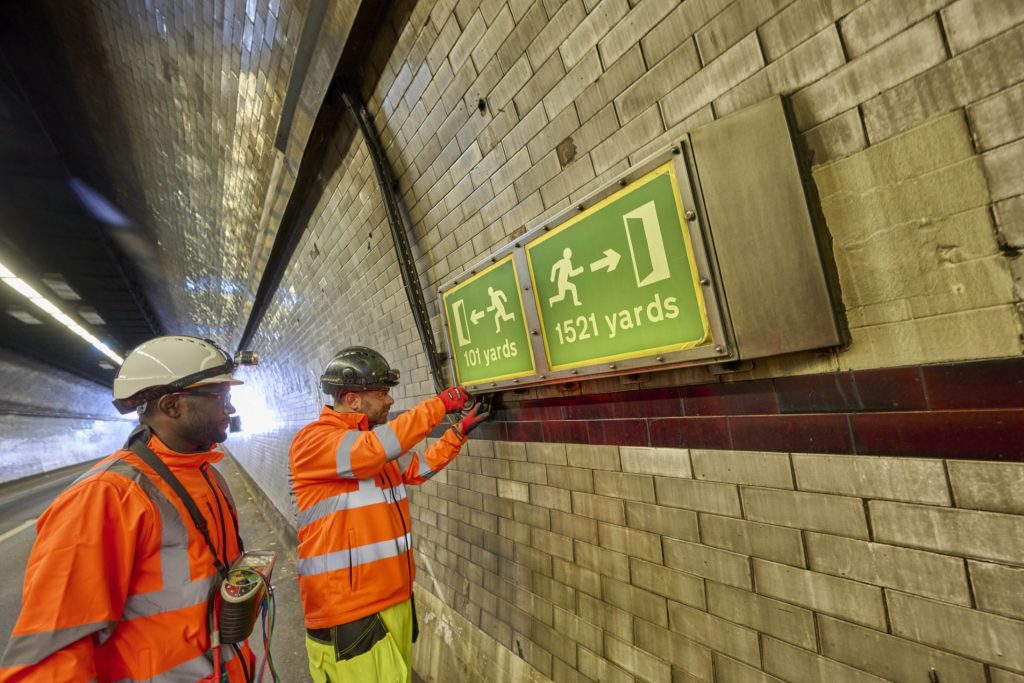
A Passcomm road tunnel signage project demonstrates the difference between simply supplying a standard product and engineering signage around a particular environment.
The project required an illuminated Emergency Exit “Running Man” sign, but the available tunnel profile created a significant physical constraint. A conventional illuminated sign was too deep for the required location.
The solution therefore needed to be considerably slimmer while continuing to provide the visibility and performance expected from emergency signage.
Reducing the enclosure depth created another technical challenge. With less internal space available between the LEDs and the sign face, it becomes more difficult to diffuse the light evenly. Individual LED points can become visible, producing brighter and darker areas across the graphic.
The product therefore had to be designed so that the slim profile did not compromise illumination quality. A stainless-steel construction was also used to create a robust product suitable for the demanding tunnel environment, where equipment can be exposed to moisture, pollution, brake dust and other contaminants.
Rather than starting with a standard sign and attempting to make it fit, the product was engineered around the requirements of the installation.
Designing for years, not just handover
One of the most useful measures of infrastructure design is what happens after the construction project has finished.
A product can appear successful at handover because it meets the specification, operates correctly and looks visually complete. But the more demanding test comes several years later. Tunnel equipment continues to experience vibration, dirt, moisture and continuous operational conditions long after the installation team has left site.
The Passcomm tunnel signs continuing to perform years after installation illustrates the importance of considering long-term conditions during the original design. That continued performance is not simply the result of meeting an initial compliance requirement. It reflects decisions around materials, component selection, construction, illumination and environmental suitability.
For critical infrastructure, engineering for service life should be part of the original specification rather than an afterthought.
What should specifiers look beyond compliance for?
Standards will always be one of the first considerations when selecting safety signage, but specifiers should also consider how the product will perform in practice.
Important questions include:
- Environmental resistance: Can the sign withstand the moisture, pollution, vibration, temperature variation and contaminants present at the site?
- Visibility: Will the sign be clearly visible from the positions and viewing angles in which people actually need to see it?
- Illumination: Is the sign face evenly illuminated without distracting bright or dark areas?
- Materials: Are the enclosure, fixings and internal components appropriate for the expected environment?
- Physical dimensions: Will the product fit within the available installation profile without compromising performance?
- Maintainability: Can the sign be inspected, cleaned and serviced without unnecessary operational disruption?
- Service life: Has the product been designed for long-term operation rather than simply initial commissioning?
- Mounting requirements: Can it be securely and practically installed in the intended location?
- Proven performance: Is there evidence that the design approach can perform reliably in comparable critical-infrastructure environments?
Considering these factors alongside the applicable standards creates a much more complete specification.
Conclusion: compliance sets the baseline, engineering determines performance
Compliance is fundamental to safety signage. Standards establish the baseline for how safety information should be presented and how signage should perform. But they cannot account for every tunnel profile, mounting restriction, environmental condition or operational requirement.
Good safety signage design therefore goes further. It considers where the sign will be installed, how people will see it, how evenly it will be illuminated, what environmental conditions it needs to withstand and how it will be maintained throughout its life.
Where standard products cannot satisfy those requirements effectively, bespoke engineering can provide a better solution.
Ultimately, the strongest safety signage combines compliance, visibility, durability, environmental suitability and practical engineering. Because the real measure of a safety sign is not simply whether it meets the specification on installation day, but whether it continues to perform when it is actually needed.
Get in touch to get your safety signage project started.