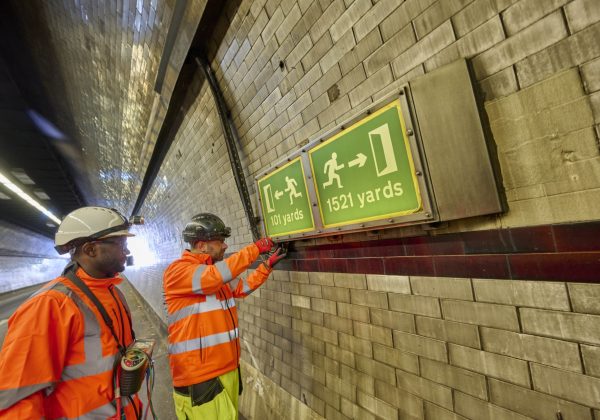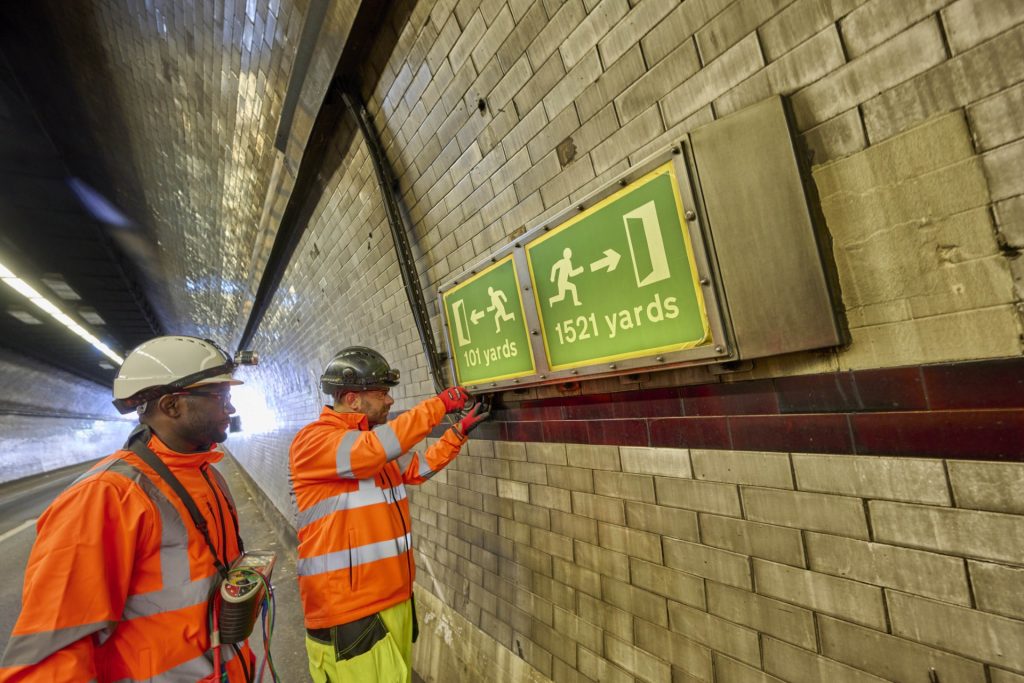
Health and safety signage in tunnels has to remain visible, legible and dependable in one of the more demanding environments found across transport infrastructure.
Moisture, vehicle emissions, brake dust, vibration and continuous operation can all affect signage over time. At the same time, maintenance access is rarely straightforward. Reaching equipment may require lane closures, traffic management, planned tunnel possessions or restricted working windows.
Reducing maintenance requirements is therefore not simply about lowering servicing costs. It can also reduce operational disruption, limit the amount of time engineers spend working in hazardous environments and help keep critical safety infrastructure available when it is needed.
The best way to achieve this is to consider maintenance at the design and specification stage rather than treating it as something that begins after installation.
Specify signage for the tunnel environment
Reducing maintenance starts with selecting equipment that is genuinely suitable for the conditions in which it will operate.
Tunnel health and safety signage may be exposed to high levels of moisture, road grime, vehicle emissions and airborne contaminants. Repeated temperature changes and vibration can place additional stress on enclosures, electrical connections and mounting systems.
A sign designed primarily for a clean indoor environment may therefore require much more frequent intervention if it is installed in a road tunnel. The enclosure, illumination system, fixings, seals and electrical components should all be selected with the operating environment in mind.
Environmental suitability should be treated as part of the original product specification rather than relying on additional maintenance to compensate for inappropriate equipment later.
Choose materials that resist corrosion
Corrosion is one of the most obvious causes of long-term deterioration in infrastructure equipment. Moisture and contaminants can gradually affect enclosures, hinges, fixings and other exposed metal components. Once corrosion begins, maintenance requirements can increase rapidly as components require cleaning, treatment or replacement.
Material selection can significantly reduce this risk. Stainless steel can be particularly useful for tunnel signage because it combines durability with strong corrosion resistance. Where the environment is especially aggressive, the grade of stainless steel and the suitability of fixings and associated components should also be considered.
It is not enough for the main enclosure to be corrosion resistant if brackets, screws or hinges deteriorate much sooner. Thinking about the complete assembly helps create signage that remains structurally sound and presentable over a longer service life.
Reduce the number of components likely to fail
Every electrical or mechanical component introduces another potential maintenance requirement. Good tunnel signage design should therefore aim for simplicity where this does not compromise safety or performance.
Modern LED illumination is useful in this respect. LEDs can provide long operational lifespans and reduce the need for regular lamp replacement compared with older lighting technologies.
A well-designed LED system can also reduce power consumption while delivering consistent illumination across the sign face. However, the quality of the components matters.
Using low-quality LEDs, drivers or power supplies may reduce the initial product cost but create a greater risk of premature failure. In a tunnel environment, replacing a failed component can be significantly more expensive than the component itself once access arrangements and traffic management are taken into account.
Reducing maintenance means considering the reliability of the complete electrical system, not simply the headline expected life of the light source.
Protect components from moisture and contamination
Keeping contaminants out of the sign can significantly improve reliability. Dust, moisture and road pollutants can affect electrical connections, lighting systems and internal electronics. Over time, contamination may also reduce illumination quality or contribute to corrosion.
The enclosure should therefore provide a suitable level of environmental protection for the intended location. Seals, cable-entry points and enclosure joints all need careful consideration. A cabinet may provide strong environmental protection overall, but poorly sealed cable entries can still allow moisture or contamination to enter.
The design should also account for how the sign behaves over many years of operation. Seals can degrade, fixings can loosen and repeated maintenance access can affect the integrity of an enclosure. Products intended for long-term infrastructure use should therefore be designed so that protection can be maintained throughout their service life.
Design signage to minimise dirt build-up
The external shape of a sign can influence how quickly it becomes dirty. Tunnel environments naturally generate road grime, brake dust and other contaminants, and signs may require periodic cleaning to maintain clear visibility.
Flat surfaces, ledges or exposed recesses can allow dirt to accumulate more quickly. Where possible, enclosure design should minimise unnecessary surfaces that trap contamination and should allow the sign face to be cleaned without complicated dismantling.
The sign face material itself also matters. A smooth, durable surface is generally easier to clean and less likely to retain dirt than one with complex joints or exposed components.
Maintenance cannot be eliminated entirely, but a product designed with cleaning in mind can make routine inspection and servicing considerably faster.
Make illumination reliable and consistent
Uneven or deteriorating illumination can create maintenance problems even when the sign itself remains physically intact. Emergency, directional and health and safety signage needs to remain clearly visible throughout its operating life. This means lighting components should be arranged so that the sign face is illuminated consistently.
Slimline signs can make this more challenging. When LEDs sit very close to the sign face, individual light sources can become visible as bright spots unless the internal optical design distributes the light effectively.
A properly engineered system uses suitable LED spacing, diffusion and internal geometry to create even illumination. Getting this right at the design stage can reduce the likelihood of visual problems appearing later and help ensure the sign continues to perform without adjustment or modification.
Avoid designs that require frequent access
Every maintenance visit creates cost and disruption. In a tunnel, this can be particularly significant because accessing equipment may require traffic management, lane closures or work during restricted maintenance windows.
The sign should therefore be designed to minimise the frequency with which engineers need to open the enclosure.
Reliable LEDs, durable power supplies and corrosion-resistant components all contribute to this. The internal arrangement should also avoid components that require routine manual adjustment where possible.
The objective should be to move towards inspection-led maintenance rather than intervention-led maintenance: engineers should be checking that the product is operating correctly rather than repeatedly repairing or adjusting it.
Make maintenance access straightforward when it is needed
Low-maintenance does not mean maintenance-free. Eventually, components may need inspection or replacement, and the design should make this as straightforward as possible.
Engineers need to be able to reach the enclosure, open it safely and access relevant components without removing unrelated equipment. Where internal power supplies, LED assemblies or connectors are replaceable, their layout should allow components to be changed efficiently.
Cable connections should be clearly identified, and fixings should be robust without making the enclosure unnecessarily difficult to open. A sign that takes an hour to service may create much greater disruption than one that can be inspected and repaired in a few minutes. Accessibility therefore forms part of whole-life maintenance planning.
Consider mounting systems as part of the maintenance strategy
The reliability of tunnel signage depends not only on the sign itself but also on how it is mounted. Repeated vibration from traffic can place stress on brackets, bolts and other fixings. Poorly designed mounting arrangements may require regular tightening or inspection and could eventually affect sign alignment.
Mounting systems should therefore be designed for the expected vibration and mechanical loads.
Corrosion resistance is also important here. A durable stainless-steel sign attached using unsuitable fixings can still develop maintenance problems at the mounting points.
Installation teams should also consider accessibility. Mounting positions that make the sign difficult to reach can substantially increase future maintenance time, even if the product itself is simple to service. The signage and its mounting arrangement should therefore be treated as one system.
Design around vibration
Road tunnels create continuous mechanical stress. Traffic movement can cause low-level vibration through the tunnel structure, and although individual movements may be small, their cumulative effect over many years can be significant.
Electrical connections, mounting points and internal components should therefore be secured appropriately. Cable strain relief is important, particularly where cables enter the enclosure. Unsupported connections can gradually loosen or become damaged if movement is transferred directly to terminals.
Internal components should also be mounted securely so they cannot shift or vibrate against the enclosure. Designing for long-term mechanical stability helps reduce faults that would otherwise require difficult and potentially disruptive maintenance visits.
Reduce heat where possible
Heat can shorten the lifespan of electrical components. Although LED lighting is more efficient than many older illumination technologies, drivers, power supplies and LEDs themselves still generate heat.
In a compact enclosure, particularly a slimline sign, there may be limited space for that heat to dissipate. Thermal management should therefore form part of the design.
This does not necessarily mean installing active cooling, which would introduce additional components and maintenance requirements. Instead, enclosure construction, component positioning and material selection can often help manage heat passively.
Avoiding unnecessary thermal stress can increase the life of LEDs and electrical components and reduce the likelihood of premature failure.
Use modular components where practical
When a failure eventually occurs, the amount of equipment that has to be replaced can make a major difference to maintenance time and cost.
A modular design can allow individual components to be replaced without changing the entire sign. For example, a driver or lighting module that can be accessed and exchanged individually may be preferable to a design in which the complete unit has to be removed.
Modularity can also help with long-term asset support. If replacement components remain available, engineers may be able to maintain the original enclosure for significantly longer rather than replacing otherwise serviceable infrastructure.
This needs to be balanced against environmental protection. Too many removable elements can create additional joints and sealing requirements. The best design achieves practical serviceability without compromising reliability.
Standardise designs across the tunnel
Where a tunnel contains large quantities of health and safety signage, standardisation can simplify long-term maintenance.
Using consistent enclosure designs, fixings, electrical connections and components reduces the number of spare parts maintenance teams need to hold. Engineers also become familiar with how each product is accessed and serviced.
If every sign type uses a different power supply, bracket or internal layout, maintenance becomes more complicated and spare-parts management becomes more expensive. Standardisation does not mean every sign must be identical. Exit, directional and emergency information will naturally vary.
However, common construction methods and replaceable components can make the entire signage estate easier to support.
Plan replacement components and lifecycle support
Infrastructure signage may remain installed for many years. One challenge is ensuring replacement parts are still available when maintenance is eventually required.
Where possible, the specification should consider the long-term availability of key components such as drivers, LED modules, power supplies and sealing systems.
Using highly unusual components may solve an immediate design problem but create future difficulties if replacements become unavailable. Manufacturers and suppliers should therefore consider lifecycle support as part of the overall solution.
Maintaining records of component specifications and providing suitable replacements can significantly extend the useful life of installed signage.
Use inspection to prevent unnecessary failures
Routine inspection still has an important role even where equipment has been designed to minimise maintenance.
The difference is that inspection should identify developing problems before they result in failure. Engineers can check illumination levels, enclosure condition, fixings, seals and visible corrosion during scheduled maintenance windows.
Cleaning can also be completed before contamination significantly affects visibility. This preventative approach is usually far more efficient than waiting for a sign to fail and then arranging an emergency intervention.
Inspection intervals should reflect the operating environment and the criticality of the signage rather than being based solely on generic schedules.
Consider whole-life cost when specifying signage
The cheapest sign to purchase is not necessarily the cheapest sign to operate. A lower-cost product that requires frequent cleaning, repeated component replacement or early enclosure repairs can create substantially greater lifetime costs.
In a road tunnel, access costs can make this difference even more pronounced. Traffic management, lane closures, specialist engineering resource and restricted working hours may mean that the cost of reaching a sign far exceeds the cost of the replacement component.
Whole-life specification should therefore consider product lifespan, component reliability, cleaning requirements, corrosion resistance and maintenance accessibility alongside the initial purchase price.
Spending more on durability at the outset can reduce considerably larger operational costs later.
Bespoke signage can reduce maintenance where standard products are unsuitable
Standard signage is appropriate for many installations, but it is not always the best choice for a constrained tunnel environment.
A standard product may physically fit only with awkward mounting arrangements, restricted maintenance access or exposure to conditions it was not designed to withstand. In these cases, a bespoke product can reduce long-term maintenance by addressing those constraints directly.
A purpose-engineered sign can be designed around the available installation depth, required viewing position and environmental exposure while incorporating suitable materials and reliable illumination.
The aim is not customisation for its own sake. Bespoke engineering is most valuable when it eliminates compromises that would otherwise create recurring operational or maintenance problems.
How Hybrid approaches tunnel signage design
We have experience developing signage and supporting infrastructure for demanding transport environments, including bespoke road tunnel applications.
Rather than treating the sign as an isolated product, the design approach considers the physical installation, environmental exposure, illumination requirements and expected operational life together. For tunnel exit signage, this can include stainless-steel construction, slimline enclosure design and carefully engineered LED illumination where installation depth is restricted.
These considerations help produce equipment that can continue operating in an environment exposed to moisture, pollution, brake dust and vibration.
The objective is to reduce the need for intervention over the life of the product while ensuring the signage remains clear and dependable when it is required.
Conclusion: reduce maintenance through better design
The most effective way to reduce tunnel signage maintenance is to design the need for intervention out of the product wherever possible.
That means selecting materials that resist corrosion, protecting electrical components from contamination and using dependable illumination systems designed for long-term operation.
It also means thinking about practical issues such as cleaning, vibration, mounting, thermal management and access before the equipment is installed.
Maintenance will always remain necessary to some degree, particularly for safety-critical infrastructure. But a well-engineered sign should make routine inspection simple and unscheduled intervention rare.
For tunnel operators and infrastructure contractors, the result is not only lower maintenance cost. It also means fewer closures, less disruption and greater confidence that safety signage will continue to perform throughout its intended service life.